
What Does Custom Furniture Really Mean? A Designer's Guide to Fabrics, Finishes and COM
When you hear the words custom furniture, what comes to mind?
For some people, it means a sofa built completely from scratch. For others, it simply means choosing a different fabric from the one shown on the showroom floor.
The truth is that custom furniture can mean many different things.
A piece does not have to be designed from the ground up to be considered custom. In fact, most custom furniture starts with an existing frame or design. What changes is the amount of control you have over how that piece is finished.
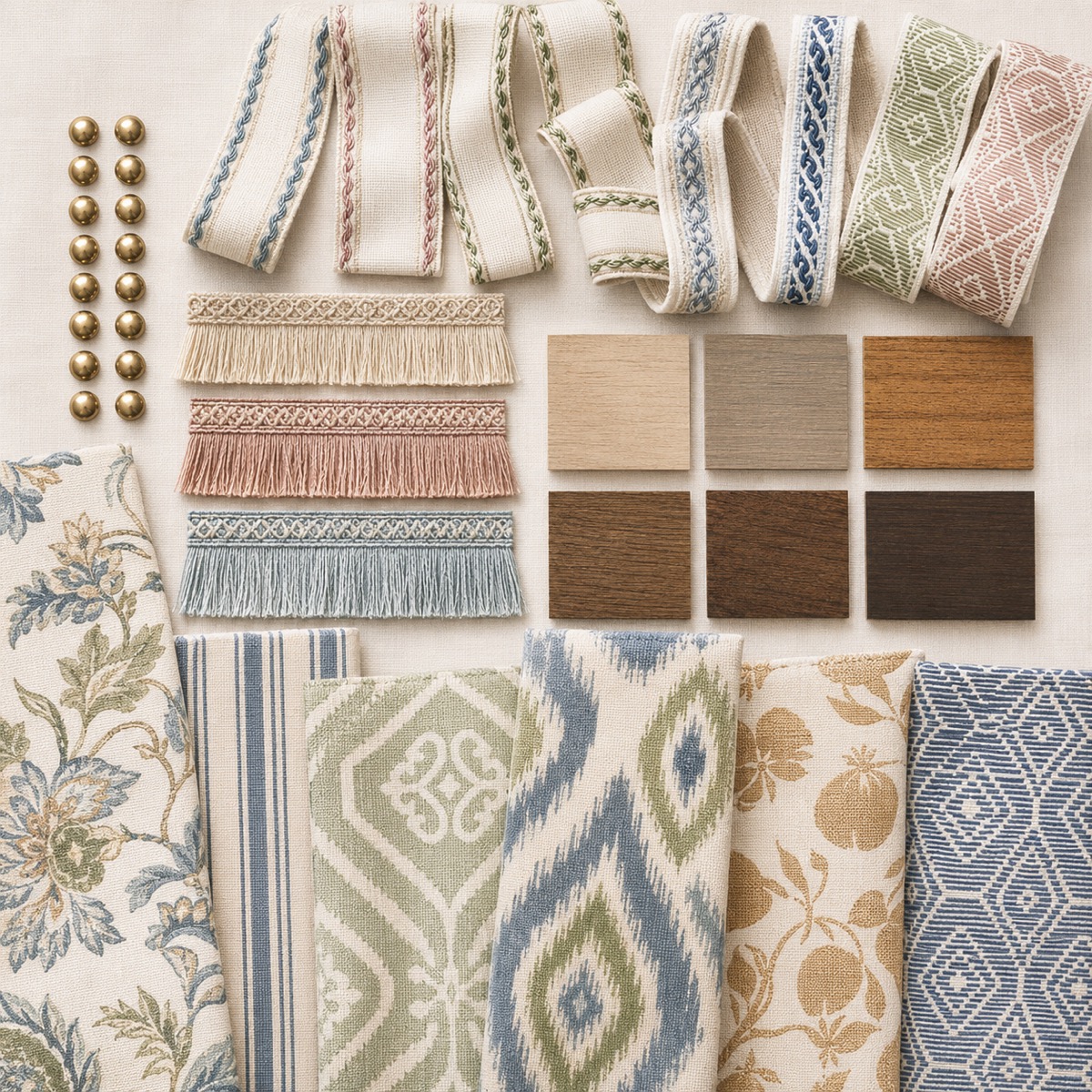
You may be able to choose a different wood stain. You might have hundreds of upholstery fabrics available instead of the five shown online. You may be able to add contrast welting, decorative tape, nailheads or a patterned fabric to the outside back of a chair.
Some manufacturers will even change the dimensions of a table, sectional or other piece.
At an even higher level, certain furniture companies allow you to provide your own fabric and have the furniture upholstered in it.
The important question is not simply:
"Is this custom?"
It is:
"Exactly what can I customize?"
Because the answer varies enormously from one furniture manufacturer to another.
The Different Levels of Custom Furniture
It helps to think about customization in levels, starting with relatively simple changes and moving toward furniture that can become highly personalized.
Level One: Choosing the Finish
Wood furniture is one of the simplest examples of customization.
A mass-market dining table may be offered in one finish. What you see online is what you get.
Move into better-quality furniture, however, and the same table may be available in several wood stains, painted finishes or combinations of the two. And some manufactures will even allow you to choose from over a dozen types of distressing options for the wood, from lightly distressed to heavily distressed with old world character.
That can make a big difference.
Perhaps you love the shape and scale of a console, but the dark walnut finish feels too heavy for your room. If it can be ordered in a warm medium oak, suddenly the piece works.
Finish options are also helpful when furnishing several pieces in the same room.
Your dining table, chairs and buffet do not need to be an exact matching set, but you may want the wood tones to relate to one another. Having several finish choices gives you much more control over the finished room.
Depending on the manufacturer, wood furniture customization might include:
- Wood stain
- Painted finish
- Distressing
- Tabletop treatment
- Leg style
- Hardware
- Edge profile
- Table size
For many homeowners, this is the first introduction to custom furniture.
Level Two: Choosing Your Upholstery
This is where the options start expanding dramatically.
A chair might appear online in six fabrics, but that does not necessarily mean those are your only choices.
Many better furniture manufacturers offer hundreds of additional fabrics and leathers, with some offering more than 1,000 choices.
Those options often cannot realistically be displayed online.
That is why I tell clients not to reject a sofa or chair simply because they do not like the fabrics shown on the website. Similarly, you may circle a showroom and be unimpressed by the ocean of beige sofas and chairs, not realizing that with customization that chair can be done in 100,000 different personalities.
There may be an entirely different fabric library available through a showroom or designer.
And changing the upholstery is only the beginning.
Custom Upholstery Can Be About the Details
Some of the most interesting furniture customization has very little to do with simply choosing between beige, blue or green.
Depending on the manufacturer and frame, you may be able to specify:
- Upholstery fabric or leather
- Dual fabrics
- Contrast welting
- Nailheads
- Cushion construction
- Wood finish
- Skirt style
- Decorative tape
- Fringe
- Trim
- Throw pillow fabrics
- Outside-back fabric
This is where a chair or sofa can begin to feel truly personal.
One of my favorite examples is an upholstered dining chair.
You might put a durable neutral on the seat and inside back, then use a beautiful pattern on the outside back.
You get the impact of the pattern without covering the entire chair in it.
The same idea works beautifully on an accent chair that floats in the middle of a room. A quieter fabric can go on the front while a stripe, floral, print or texture is used on the back.
Suddenly the back of the chair becomes part of the room's design.
Do Not Forget the Pillows
Sofa pillows are another opportunity that is often overlooked.
Depending on the manufacturer, you may be able to use:
- A patterned pillow with a solid sofa
- Contrast welting
- A different fabric on the front and back
- Coordinating fabrics across several pillows
- Decorative trim or fringe
These sound like small details, but they are often what make a room look collected and designed rather than purchased as a matching set.
And if your Pinterest boards are filled with chairs edged in beautiful tape trim, sofas with contrast piping and pillows finished with decorative cord, those details may be more attainable than you realize.
Level Three: Changing the Size
Sometimes customization is not primarily decorative.
Sometimes it solves a problem.
You may find a dining table you love, but the standard 84-inch version feels too small for the room while the 108-inch version is too large.
What you really need is 94 inches.
Certain furniture manufacturers offer programs that allow you to select or modify the length, width or height of a table.
Bermex (a line carried at Furnitureland South) also offers custom-size dining table programs where you can change the size, the base, the table edge shape, the stain, the level of distressing, and more.
That is a very different kind of customization from choosing a stain or fabric.
It can allow you to choose furniture based on the proportions your room actually needs instead of forcing your room to work around standard furniture dimensions.
The same principle applies to sectionals and modular upholstery. Different combinations of arms, corner pieces, chaises and seating units can sometimes create a configuration that fits a room considerably better than an off-the-floor sofa and loveseat combination.
Custom Rugs Solve the Same Problem
Rugs are another category where exact sizing can be useful.
Most rugs are sold in familiar sizes such as:
- 5' x 8'
- 8' x 10'
- 9' x 12'
- 10' x 14'
But your room does not know it is supposed to conform to standard rug sizes.
A dining room might really need a 10'3" x 13'6" rug.
A hallway may need an unusually long runner.
A large living room may need something between two standard sizes.
Higher-end rug manufacturers, including STARK, offer custom sizing on selected products. Some programs also allow considerably more customization of color, pattern and shape.
Again, custom does not necessarily mean extravagant.
Sometimes it simply means getting the proportions right.
Where Do You Actually Find Custom Furniture?
This is the part that can be confusing for consumers because furniture customization is not organized the same way everywhere.
The amount of customization available depends primarily on the manufacturer, but the retailer determines which manufacturers you have access to.
There are three basic shopping models worth understanding.
Single-Brand Retailers: A Consistent Custom Program
A retailer such as Ethan Allen sells its own furniture brand.
That means its customization program is relatively consistent across the collection, although the exact options still vary from one frame to another.
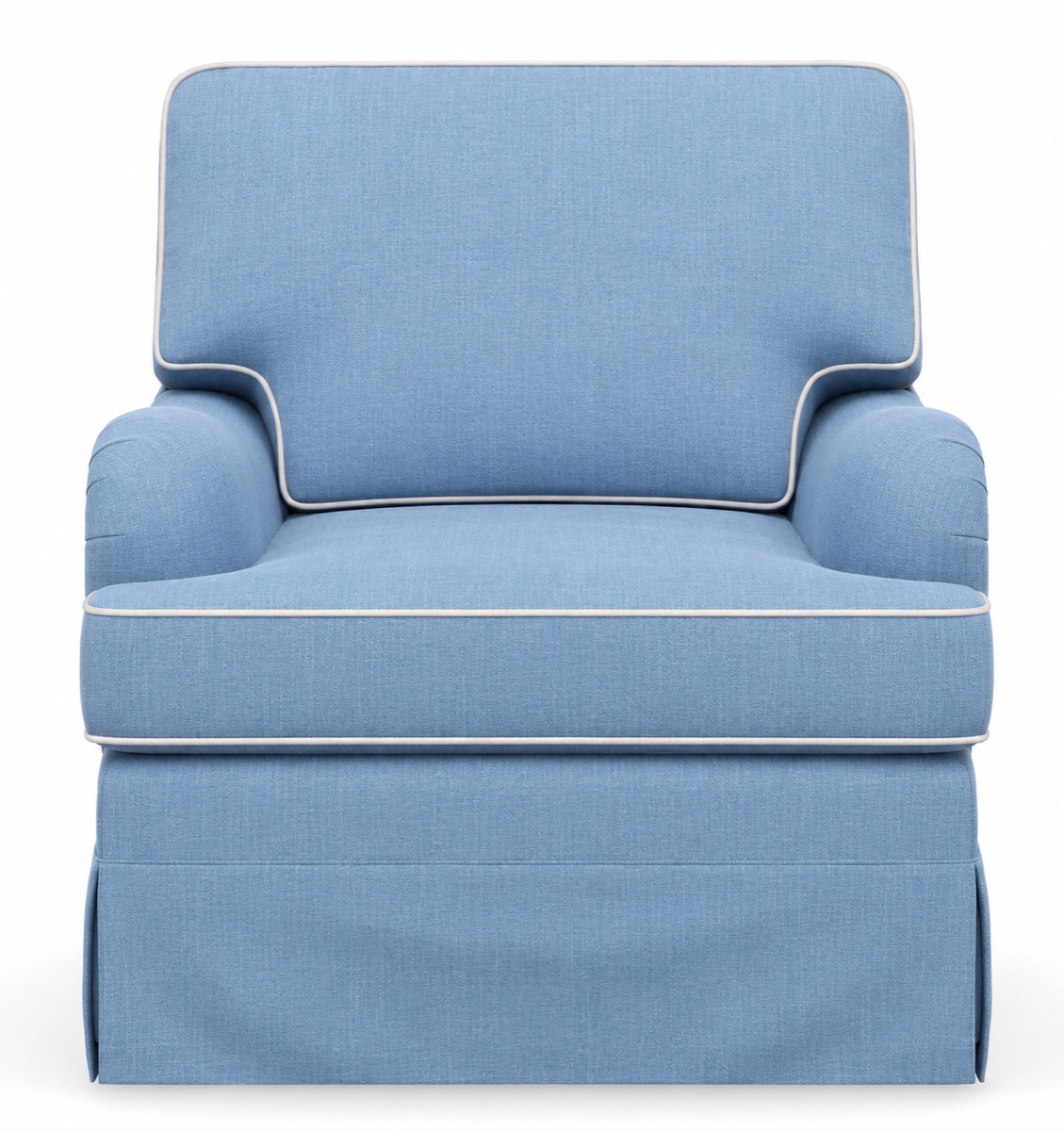
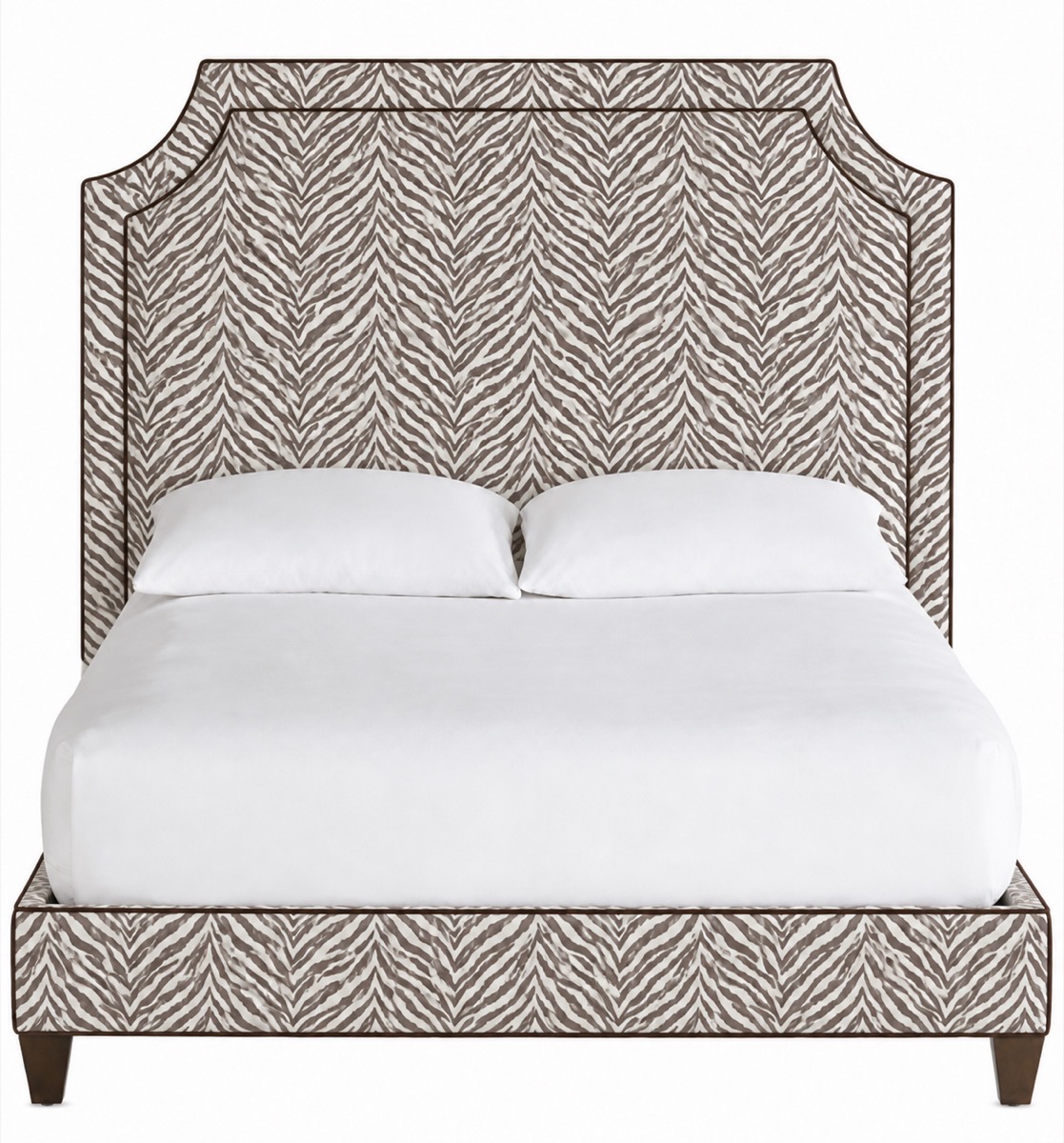
Many upholstered pieces offer extensive fabric selections along with options such as dual fabrics, contrast welting, nailheads, different wood finishes and custom pillows. Here you can see the Monica swivel chair with a custom white welt and skirt option. Maybe you want a bold upholstered bed with an animal print. The Lianna bed can be done in over 1,000 fabrics or leathers, and you can also add a contrast welt, nailhead or tufting.
Many wood pieces also offer additional finish choices, and some dining tables provide options for size, top treatment, leg style and finish.
There is an advantage to this model.
You are learning one company's customization system rather than comparing the rules of many different furniture manufacturers.
It can provide quite a bit more flexibility than consumers realize, particularly because many of the choices available through a Design Center are not obvious when simply browsing furniture online.
Multi-Line Showrooms: More Manufacturers Mean More Options
A retailer such as John Kilmer Fine Interiors works differently.
Rather than selling a single furniture brand, it represents multiple premium manufacturers.
That expands your options, but it also means the customization rules change from manufacturer to manufacturer.
One sofa company may offer hundreds of fabrics and several finish choices.
Another may allow custom dimensions.
Another may accept COM (customer's own material).
Another may allow extensive decorative trim.
This is an important distinction whenever you shop at a multi-line furniture showroom:
The retailer does not determine all of the customization options. The individual furniture manufacturer does.
And that brings us to the largest version of this shopping model.
Furnitureland South: Where Custom Furniture Really Opens Up
If you have been pinning pictures of chairs with tape trim, sofas with contrast welting, patterned outside backs and beautifully detailed upholstery, Furnitureland South in Jamestown, North Carolina is one of the best resources to know about.
This is where the idea of custom furniture becomes much bigger.
Furnitureland South represents more than 1,000 furniture and home furnishing manufacturers, with thousands of fabric and finish samples available through its Design Center. Approximately 90 percent of its furniture is customized for clients.
The significance of Furnitureland South is not simply that it is enormous.
It is the number of different customization programs available under one roof.
One manufacturer might offer 50 fabrics and several wood finishes.
Another might offer hundreds of fabrics, multiple cushion constructions, nailhead options and contrast welting.
Another may offer tape, fringe, trims, outside-back fabrics, custom pillows or dual upholstery.
Another may allow you to customize the dimensions of a dining table.
Another may accept your own fabric (COM).
That is an entirely different shopping experience from scrolling through finished furniture online.
Bring Your Pinterest Pictures
This is where I think Furnitureland South is especially useful.
If you have been saving pictures for years of furniture you love, bring the pictures with you.
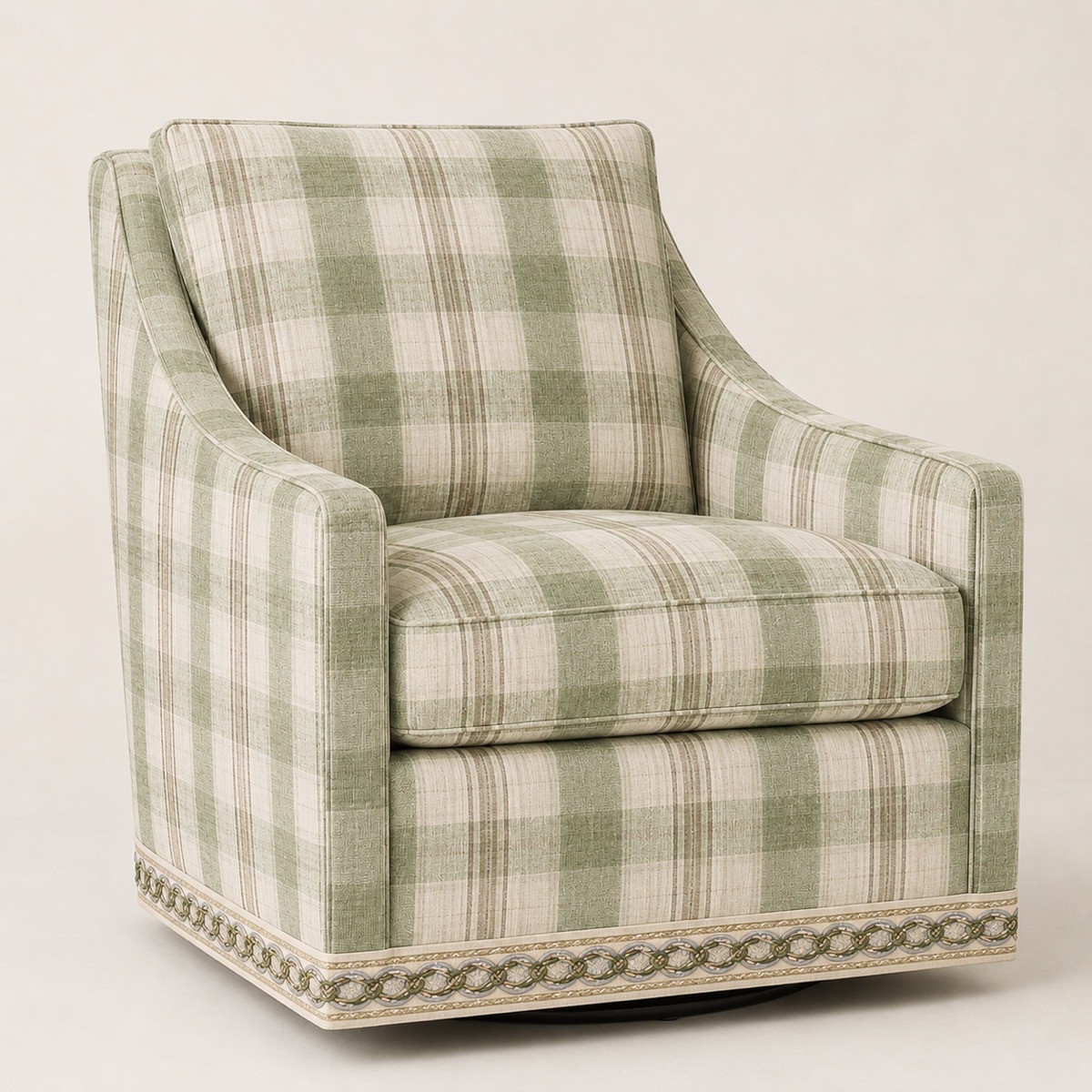
Maybe it is a chair with an embroidered tape running around the skirt.
Maybe it is a sofa with a beautiful fringe on the base.
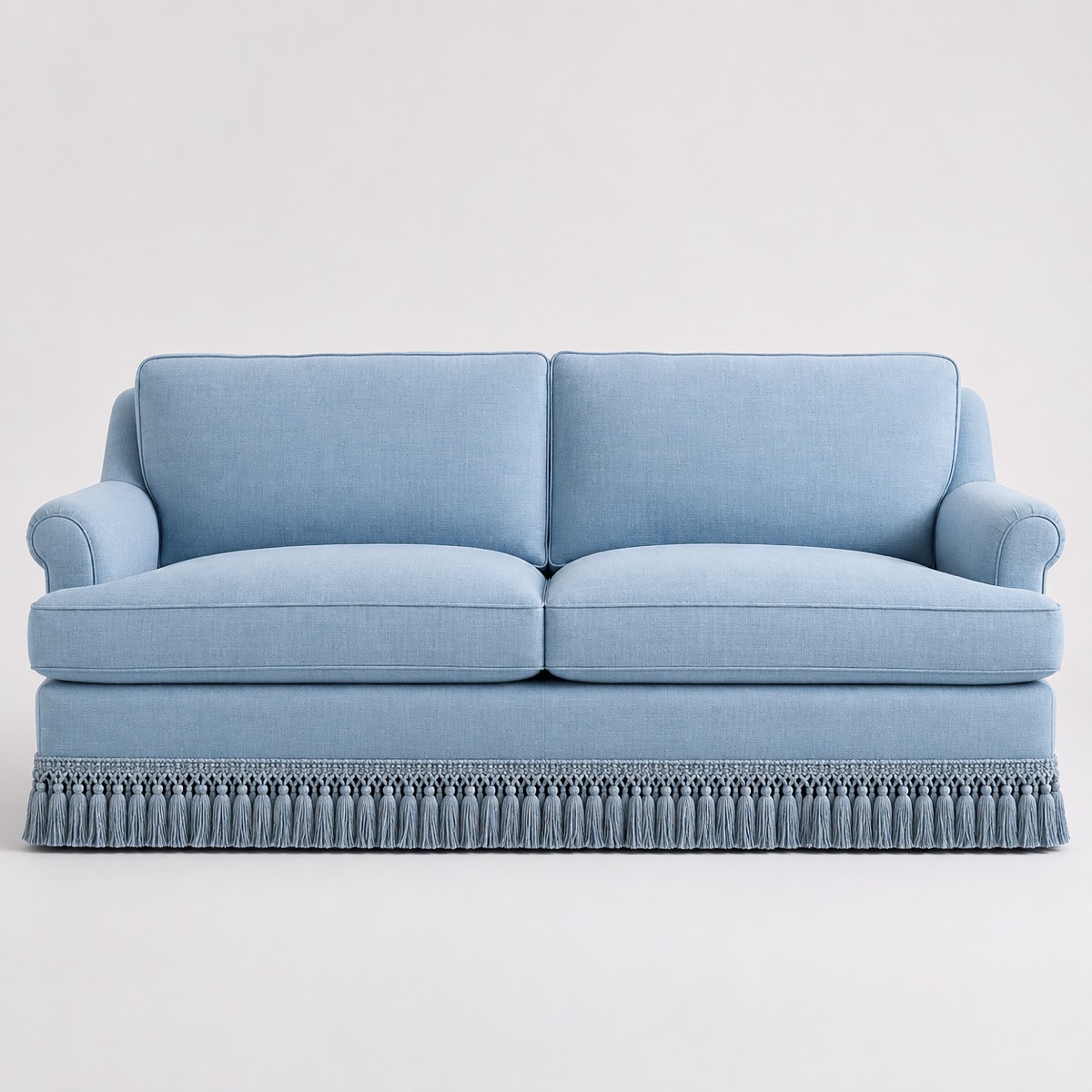
Maybe you love a dining chair with a patterned outside back.
Maybe it is the combination of a solid chair fabric with a beautiful trim along the base.
You do not necessarily need to find the exact furniture piece shown in the photograph.
Instead, look at what you love about it.
Is it the frame?
The fabric?
The trim?
The welt?
The skirt?
The outside back?
The wood finish?
Once you identify those elements, a designer may be able to help you find an existing furniture frame from one manufacturer and use its customization program to create the look you have been saving.
That is when furniture shopping becomes much more interesting.
Instead of asking:
"Which one of these chairs should I buy?"
You can start asking:
"How do I want this chair to look?"
And Furnitureland South gives you access to an unusually large number of manufacturers with very different answers to that question.
The Next Level: COM
Once you start exploring higher levels of furniture customization, you may come across the letters COM.
COM stands for Customer's Own Material.
In simple terms, you find a chair or sofa frame you love, but instead of selecting one of the manufacturer's upholstery fabrics, you provide your own.
The manufacturer then upholsters the piece in your material.
This can be incredibly useful if you find a fabulous textile through a fabric company such as Kravet, Thibaut, Schumacher or another fabric house and want to use it on a particular furniture frame.
It allows the furniture and fabric to be sourced independently.
For someone who wants a truly distinctive chair or sofa, that opens another level of possibility.
Which Furniture Manufacturers Allow COM?
COM policies vary considerably.
Century Furniture specifically offers Customer's Own Material on eligible upholstery.
Vanguard Furniture accepts COM as well as COL, or Customer's Own Leather, on eligible furniture. Vanguard also offers extensive customization beyond upholstery, including trims, welts, finishes and custom-sized dining tables.
Arteriors has a COM program covering selected upholstered chairs, swivel chairs, sofas, settees, chaises, benches and ottomans.
Bassett also offers Customer's Own Material capabilities on eligible upholstery.
Many brands at Furnitureland South may also be ordered using COM, depending on the piece.
Other furniture manufacturers do not offer traditional COM at all.
Ethan Allen, for example, requires customers to choose from fabrics and leathers within its own upholstery program rather than supplying an outside fabric.
Neither approach is inherently better.
The important thing is understanding what the manufacturer allows before falling in love with a particular plan for the piece.
COM Comes with an Important Catch
COM creates tremendous flexibility, but it also transfers some responsibility to you.
When a furniture manufacturer supplies fabric from its own upholstery program, that material has generally been selected and approved for use on its furniture.
When you supply the fabric yourself, the manufacturer may inspect it for suitability, but that does not necessarily mean the furniture company guarantees its performance.
The Other Catch: Custom Furniture Is Usually Final Sale
This may be the most important thing to understand about custom furniture.
Once you customize it, you generally cannot change your mind.
If a company builds a sofa in your selected fabric, stains a dining table in your chosen finish or produces a piece to your specified dimensions, that furniture becomes much more difficult for a retailer to resell.
Custom orders therefore tend to have much stricter cancellation and return policies.
That is why every detail should be verified before an order is placed.
Check:
- The exact frame
- Dimensions
- Fabric number
- Fabric direction
- Finish
- Nailheads
- Welting
- Trim
- Pillow selections
- Cushion construction
- Table dimensions
- Hardware
Then check it again.
Measure Twice. Then Measure Again.
Custom furniture can solve an enormous number of design problems.
It can also create a very expensive one if the measurements are wrong.
Before ordering, verify:
- Actual room dimensions
- Door widths
- Hallways
- Elevators
- Staircase turns
- Ceiling heights
- Furniture clearance
- Dining chair pullout space
- Window locations
- Electrical outlets
- Floor vents
- Traffic paths
Do not simply ask:
"Will this sofa fit in the room?"
Ask:
"Will this sofa fit through everything it needs to pass through to reach the room?"
Those are two very different questions.
Is Custom Furniture More Expensive?
Generally, custom furniture is more expensive than stocked furniture that is imported from overseas. However, when shopping in a showroom like Furnitureland South, Bassett or Ethan Allen, if you are looking at the price tag on a floor model and want to change the fabric for something different, it may or may not be more. In fact, sometimes it can be less. Using Ethan Allen again as an example, since they have the largest showroom in our area, when you look at a sofa on the floor, it is priced with whatever options are on that exact sofa. Fabrics start at a grade A and move to a grade Z. Where you fall on that spectrum determines how much that sofa costs. Options like nailhead, contrast welt, contrast pillows and seat cushion can also affect the price. However, with most manufacturers, changing out the stain color of the legs or frame will not increase the cost.
When Is Custom Furniture Worth It?
I do not think every piece in a home needs to be custom.
There are plenty of times when an in-stock sofa, standard dining table or readily available chair is exactly the right choice.
Customization becomes particularly worthwhile when:
Your room needs an unusual size
A custom table, sectional or rug may fit much better than trying to force a standard size into the space.
The furniture is a focal point
If the back of a chair is prominently visible from another room, that beautiful patterned outside back or decorative trim can have a tremendous impact.
You love the frame but not the finish
Before eliminating a piece, find out whether additional finishes are available.
You are coordinating several rooms
Related fabrics, trims and wood tones can create continuity through a home without making every room match.
You have found the perfect fabric
COM may allow you to pair that textile with a furniture frame you love.
You have an inspiration picture you cannot find anywhere
Instead of trying to locate the exact chair you saved on Pinterest, break down what you love about it. The look may be achievable through customization.
You plan to keep the piece for many years
Spending more to get exactly what you want makes considerably more sense on a quality dining table or sofa you expect to own for 15 years than on a trendy accent piece you may replace in three.
The Biggest Lesson: Ask What Else Is Available
This is probably the most important takeaway from the entire discussion.
When you see furniture online, do not automatically assume you are seeing every available option.
Sometimes you are.
But sometimes the website is showing 10 popular fabrics out of hundreds.
There may be finishes that are only shown in a showroom.
The chair may be available in two fabrics even though you have never seen it photographed that way.
You may be able to add a contrast welt.
You may be able to change the skirt.
You might be able to add tape or trim.
The table might be available in another size.
And with some manufacturers, you may even be able to bring your own fabric.
That is what makes custom furniture so interesting.
You are no longer limited to asking:
"Which one of these choices will work?"
You can start asking:
"What do I actually want this piece to be?"
And if your Pinterest boards are full of beautifully detailed furniture that you cannot seem to find online, a resource such as Furnitureland South may be exactly where it makes sense to start looking.
Need Help Furnishing Your Lowcountry Home?
Whether you are furnishing a new construction home, updating an existing space or deciding where customization is worth the additional investment, I can help you sort through the options.
Sometimes custom furniture is absolutely worth it.
Sometimes a standard piece is the smarter buy.
And sometimes the answer is not finding a different chair or sofa at all. It is discovering that the piece you already love can be customized in ways you did not know were available.
The goal is not to make everything custom.
It is to know where customization will make the biggest difference in how your home looks, functions and feels.