
How Many Stores Should You Shop When Furnishing an Entire House?
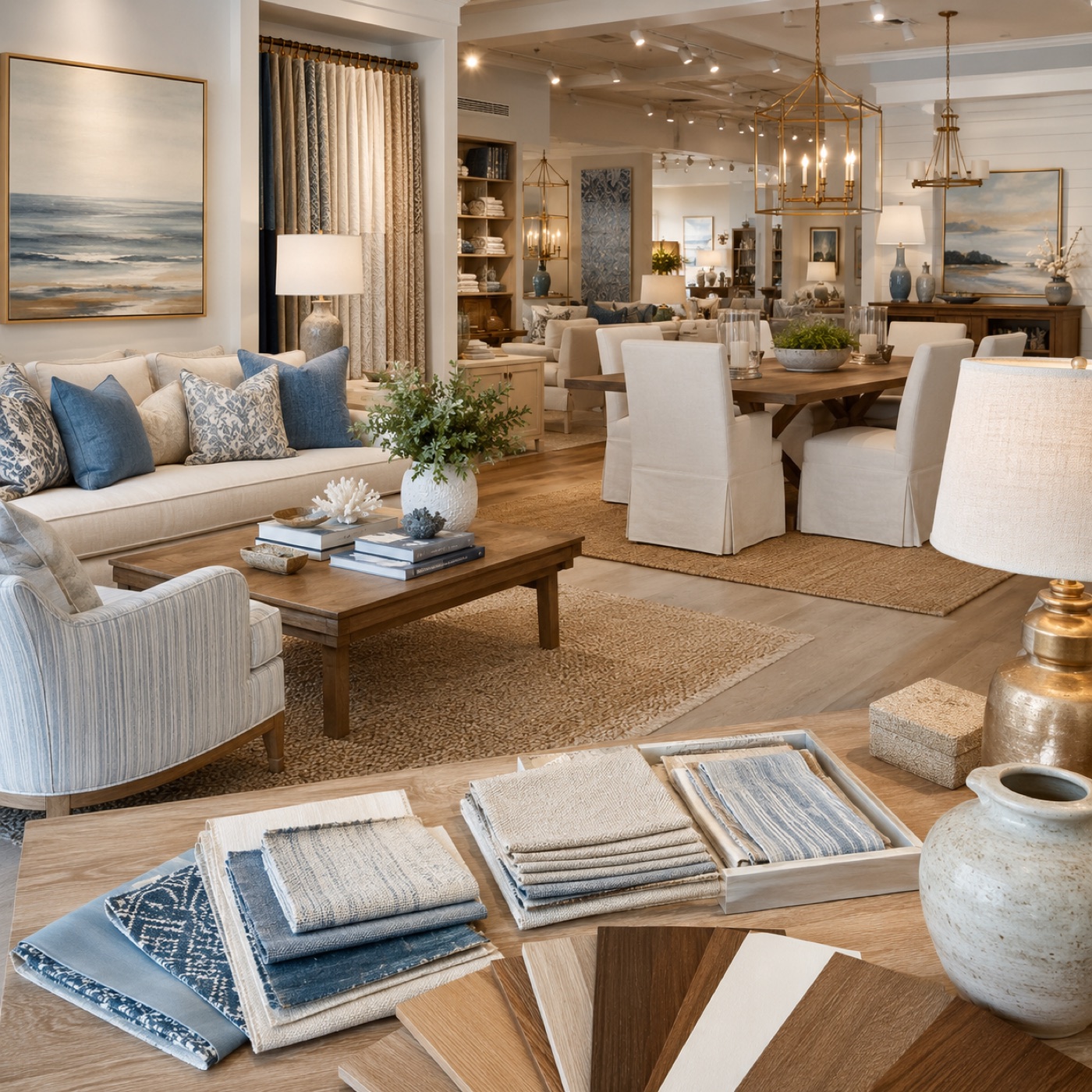
When furnishing an entire home, clients often ask me how many stores they should expect to shop from.
The honest answer is: there is no ideal number.
Some homes can be furnished primarily through two or three retailers. Others may require six, eight, or even more sources to achieve the right mix of quality, price, function and personality.
The goal is not to shop from as few places as possible, or as many places as possible. The goal is to make thoughtful decisions about where each item should come from while keeping the overall process manageable.
Start With the Logistics
Before we begin looking at sofas, rugs, or dining tables, I consider how and when the furniture will be delivered.
This is especially important for out-of-town clients who are building, renovating, or purchasing a second home in Bluffton or Hilton Head. They may not be in town to accept individual deliveries, and their home may not be ready when furniture becomes available.
In these situations, storage policies matter.
National retailers such as Ethan Allen, Bassett, Arhaus and Serena & Lily offer complimentary storage for a certain period, which can make the process much easier. Instead of coordinating multiple deliveries while construction is still underway, furnishings can be held until the home is ready.
These retailers are also helpful for clients who live elsewhere because they can often visit a showroom near their current home. I can propose a fabric, leather, wood finish, or furniture style, and the client can see it in person without having to travel to Bluffton for every decision.
For remote clients, that convenience can be extremely valuable.
Consider the Cost of Multiple Deliveries
There is another practical reason not to order every item from a different store: delivery fees.
Ordering from ten retailers may give you plenty of variety, but it may also mean paying ten separate delivery charges. White-glove delivery fees can add up quickly, especially when ordering large pieces such as sofas, beds, dining tables and case goods.
Sometimes the better value is to consolidate several purchases with one retailer. Other times, a lower-priced or more distinctive item from another source is still worth the additional delivery fee.
I look at the total cost, not just the price shown on the furniture tag.
Understand the Return Policies
Return policies also vary widely.
Many people are accustomed to ordering clothing or small household items online and returning them easily. Furniture is often very different.
Custom upholstery, special-order finishes, made-to-order rugs, and personalized furnishings are typically final sale. Even stock furniture may come with restocking fees, return shipping costs, or very limited return windows.
Before a client orders, I want them to understand:
- Whether the item can be returned
- Whether it is considered custom or special order
- Whether there is a restocking fee
- Who is responsible for return shipping
- What happens if the piece does not fit through the doorway
- How damage claims are handled
A lower price is not always a bargain if the item cannot be returned and ends up being wrong for the room.
Use Full-Service Retailers for the Important Pieces
Here in Bluffton and Hilton Head, Ethan Allen has one of the largest showrooms and the most extensive selections of fabrics, leathers, finishes and customizable furniture options.
For a primary living room, dining room, or bedroom, that level of choice can be extremely helpful. These are often the rooms where clients want comfort, longevity, customization and a more elevated look.
However, that does not mean every piece in the house needs to come from the same price level.
Does it make sense for most families to purchase a $5,000 sofa for a bonus room or loft that will be heavily used by grandchildren?
Probably not.
For casual rooms, guest spaces, playrooms, lofts and secondary bedrooms, I often work with several other local retailers that offer comfortable, attractive furniture at more approachable prices.
A whole-house plan should account for how each room will actually be used. The most expensive option is not automatically the best option.
Rugs Often Require Their Own Shopping Strategy
Rugs can be one of the most challenging categories when furnishing a new home.
A client moving into a larger house may need seven or eight rugs immediately, for the living room, dining room, bedrooms, foyer, office and other spaces.
It is rare for one furniture retailer to have eight rugs that work for the home in the right sizes, colors, patterns, materials and prices.
For that reason, I frequently source rugs separately.
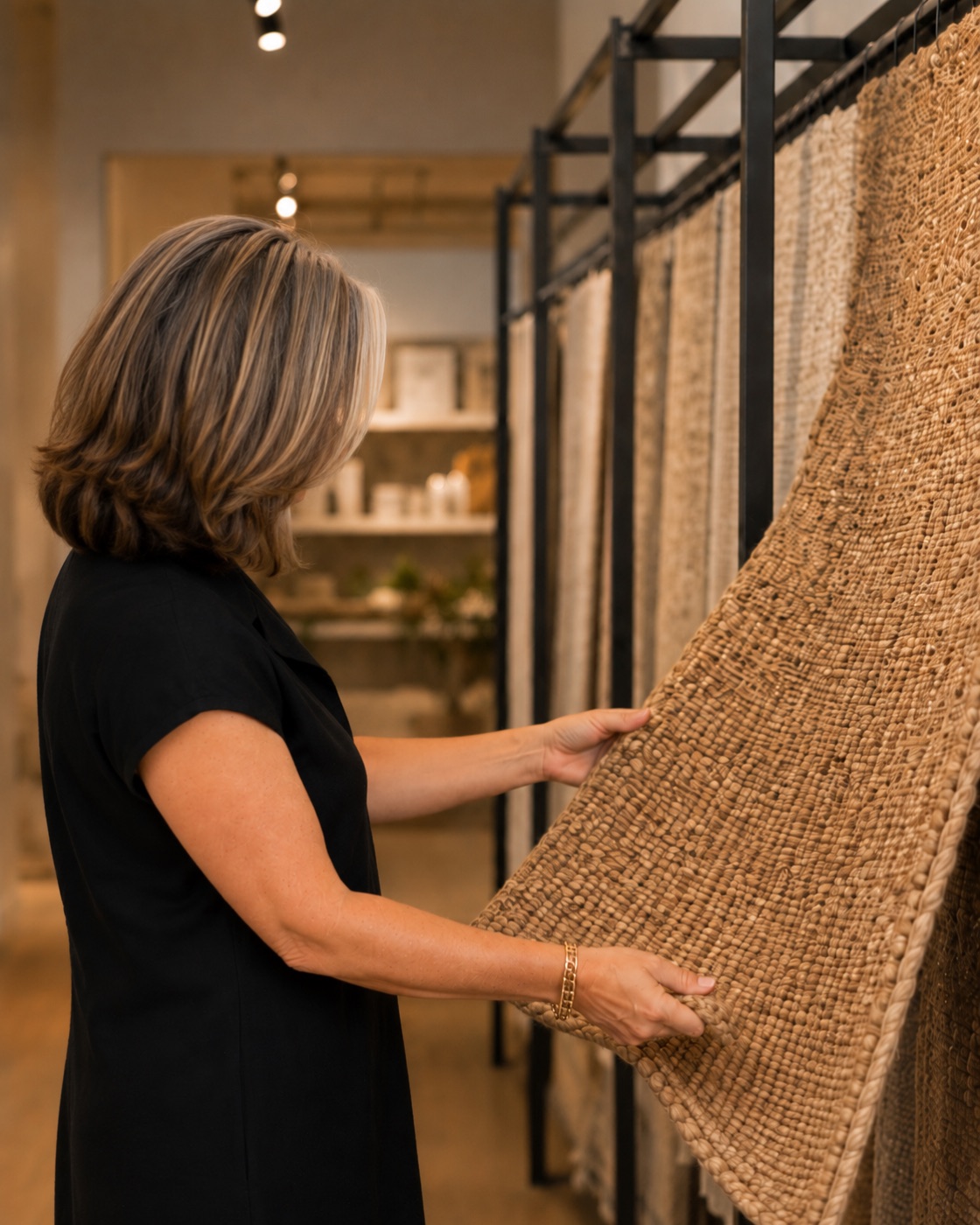
I work with a Bluffton-based retailer that displays many full-size rugs in its showroom. Seeing the entire rug laid out is incredibly helpful because a small sample does not always communicate the overall pattern or movement.
I will also travel to Furnitureland South, outside High Point, for access to its extensive rug selection. They also have the largest collection of furniture in the world, so it is a great option for other pieces if clients have very specific needs.
Should You Order Rugs Online?
You certainly can, but rugs are notoriously difficult to judge from a photograph.
Colors may appear warmer, cooler, brighter, or more muted online than they do in person. The scale of the pattern may also be difficult to understand from a cropped product image. Texture, pile height, softness, sheen and construction quality are even harder to evaluate through a screen.
Whenever possible, I prefer to see a rug in person or obtain a sample before ordering it for a client.
I keep dozens of rug samples in my studio so we can compare colors and textures against upholstery fabrics, wood finishes, wallpaper and paint selections.
A rug can influence the entire room, so it is worth taking the time to get it right.
Artwork Deserves More Than an Afterthought
Artwork is another category where shopping from multiple sources can make a home feel far more collected and personal.

Ethan Allen offers an extensive collection of higher-end artwork, along with custom art options that allow clients to select the size, frame and matting.
I have also found distinctive pieces at John Kilmer Fine Interiors on Hilton Head. Both are excellent resources when a client wants art that elevates a room beyond something that looks mass-produced or pulled from the HomeGoods aisle.
For more casual spaces, rental properties, or rooms with tighter budgets, retailers such as Coastal Home or Furniture Direct may also come into play.
Not every wall requires an investment piece. The key is knowing where to spend, where to save and how to make everything feel intentional.
Accessories Are Where Personality Comes In
For decorative accessories, Coastal Home is a great local source. It offers coastal-inspired pieces that feel more refined and less predictable than the cliche beach decor found in many big-box stores.
I also love shopping antique malls and vintage markets from Savannah to Charleston.
Antiques, vintage pieces, old books, ceramics, artwork, trays, boxes and unusual objects add history and character. They prevent a newly furnished home from looking as though everything arrived from the same catalog on the same day.
You do not need an entire room filled with antiques. Even one old chest, vintage mirror, original painting, or unique accent can make a room feel more curated.
Window Treatments Are Their Own Category
While some furniture stores like Ethan Allen offer window treatments and blinds for a one-stop furniture and decor solution, you are generally paying close to double the price compared to going directly to the same local fabricator who actually makes them.
Because whole-house window treatments can easily cost tens of thousands of dollars, navigating this area with an experienced designer who cuts out the middle man can save you a great deal of money.
Why Working With a Designer Makes Multi-Store Shopping Easier
Shopping from multiple stores gives you more options, but it also creates more opportunities for mistakes.
Wood finishes may clash. Sofa arms may feel too formal next to casual chairs. Brass finishes can lean yellow, aged, polished, or champagne. Rugs may compete with fabrics. Furniture that looks appropriately scaled in a showroom may overwhelm a smaller room.
One of the benefits of working with a designer is having someone maintain the overall vision while sourcing from different places.
I know which finishes tend to work well together and which combinations are likely to feel disconnected. I also maintain a running digital library of furnishings, rugs, artwork, lighting and accessories so clients can review options together.
That allows us to narrow down the strongest possibilities before spending design hours driving from store to store.
We still shop in person when something is a serious contender, but the process becomes much more focused and efficient.
So, How Many Stores Is Reasonable?
For a whole house, sourcing from approximately four to eight retailers is not unusual.
You might purchase most of the upholstered furniture and bedroom pieces through one or two primary retailers. Rugs may come from a specialty source. Lighting may come from another. Artwork, accessories and antiques may come from several additional places.
The exact number matters far less than having a coordinated plan.
A well-designed home should not look like a showroom for one furniture brand. It should also not feel like a collection of unrelated purchases.
The best homes include a thoughtful mix of:
- Investment pieces
- More affordable furnishings
- Custom selections
- Ready-made items
- New furniture
- Vintage or antique accents
- Personal artwork and meaningful objects
The result should feel cohesive, comfortable and reflective of the people who live there.
A designer's role is not simply to send you to one store and tell you to buy everything in a matching collection. It is to know where to shop, when to spend, where to save and how to bring selections from multiple sources together so the finished home feels intentional.