
How to Furnish a Home in Bluffton or the Lowcountry When You Live Out of State
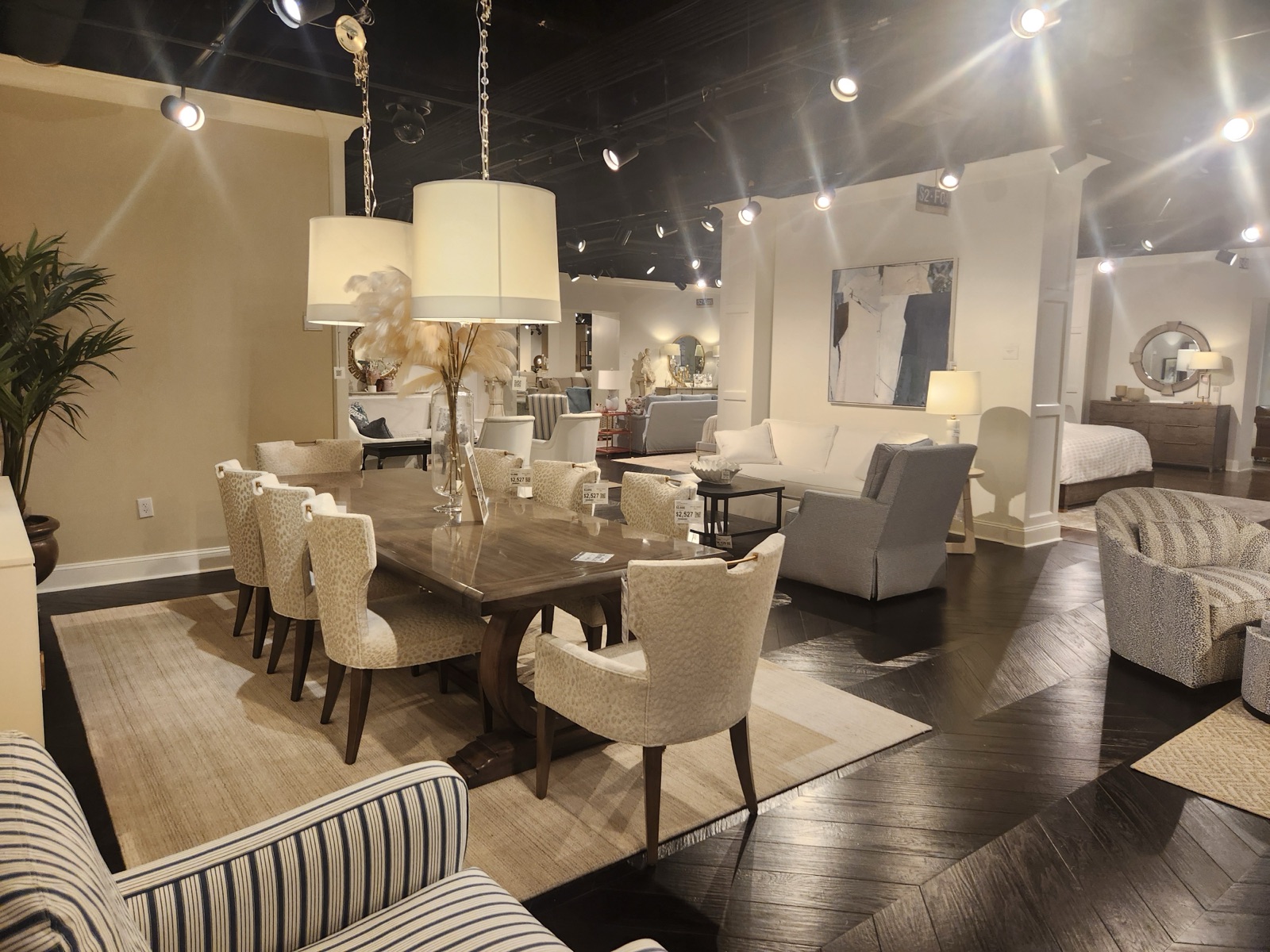
Building or buying a home in Bluffton while living in New York, New Jersey, Ohio, Colorado, or somewhere else entirely creates an interesting dilemma.
Where do you buy the furniture?
Do you shop near your current home, where it is convenient to visit showrooms? Do you order everything online? Do you hire a large interior design firm to purchase, receive, inspect, warehouse, and eventually deliver everything to your new Lowcountry home?
All of those options can work.
But after working in furniture retail, building homes myself, and now helping clients furnish homes throughout Bluffton and the Lowcountry, I believe there is often a much simpler solution.
The key is knowing where to shop, when to order, who should handle each purchase, and where everything is going to go until your house is ready.
That is particularly important when you are trying to manage the entire process from another state.
Should You Buy Furniture in Your Current State and Have It Delivered to Bluffton?
You certainly can.
If you live in New Jersey, for example, you can visit a furniture store there, place your order, and have the furniture delivered to your new Bluffton home when construction is complete.
There is one potential problem that buyers do not always think about:
What happens if something is wrong when the furniture arrives?
As a former Ethan Allen designer, I saw this situation more than once.
Someone might have purchased furniture through an Ethan Allen location in New York or Colorado and later had it delivered after moving to the Bluffton area. Then perhaps the sofa arrived with a seam they were unhappy with, a table had discoloration, or another piece had a manufacturing or delivery issue.
Naturally, they would call the Bluffton store for help.
Unfortunately, the local store had not sold the furniture.
With retailers that operate through individual design centers or territories, customer-service issues generally need to go back through the location and salesperson who handled the original transaction. The local Bluffton designer cannot simply authorize a return, remake, credit, or replacement on an order another store sold.
When you purchase locally, you have someone nearby who knows your project and can advocate for you.
At Ethan Allen, for example, your salesperson or designer is typically your first point of contact. If something needs to be evaluated, having someone local who can see the piece, document the problem, take photographs or video, and help move the issue through customer service can make the process significantly easier.
I still run a good number of my Bluff & Bay projects through Ethan Allen, which means I have a designer inside the local store supporting my clients as well.
That local relationship matters more than people realize.
You May Not Need a Design Firm to Warehouse an Entire House of Furniture
Many people building luxury homes assume there are only two choices:
- Manage all of the furniture themselves.
- Hire a high-end design firm to procure, receive, warehouse, and install the entire home.
For an ultra-high-end project with dozens of trade-only vendors, custom furnishings, antiques, specialty pieces, and a large installation team, the traditional full-service procurement model can absolutely make sense.
But many Bluffton homeowners do not need that level of infrastructure.
And if you do not need it, why pay for it?
A traditional procurement model may include receiving fees, inspection, storage, warehouse handling, furniture markup, and a final delivery or installation charge.
In some situations, furniture has essentially been delivered twice.
It is shipped from the manufacturer to a receiving warehouse. Someone unloads it, opens it, inspects it, repackages or stores it, and then another delivery team eventually loads it again and transports it to your house.
There is a legitimate cost associated with providing all of those services.
But the better question is:
Does your particular project actually require them?
Take Advantage of Complimentary Furniture Storage
One of the biggest reasons I encourage clients to develop their furnishing plan early is that many furniture retailers will hold completed furniture for a period of time while a home is being finished.
Policies vary considerably, so they always need to be confirmed before ordering.
But when complimentary or inexpensive storage is available through the retailer, it can eliminate an unnecessary layer of receiving and warehousing.
Instead of:
Manufacturer → Design Firm Warehouse → Your Home
you may be able to do:
Retailer → Your Home
That saves handling, transportation, and potentially thousands of dollars.
The trick is coordinating all of it.
You need to know the lead times.
You need to know how long each retailer will hold merchandise.
You need to understand delivery areas.
You need to know which items should be ordered early and which can wait.
You also want to coordinate purchases around sales whenever possible without waiting so long that furniture will not arrive when you need it.
That is one of the areas where Bluff & Bay helps clients who are building from out of state.
Work With Furniture Stores in Both States
You also do not necessarily have to choose between shopping where you currently live and shopping in Bluffton.
You can do both.
I frequently work with clients through national retailers that have locations in multiple markets, including:
- Ethan Allen
- Bassett
- Arhaus
- Serena & Lily
- RH
- Other national and regional furniture retailers
There is a common practice in the furniture industry sometimes referred to as a design assist.
You can visit a showroom near your current home and explain that you are working with a designer in Bluffton and ultimately plan to place the order through the appropriate store or contact serving your Lowcountry home.
That allows you to sit on the sofa, test the chair, look at wood finishes, feel fabrics, and see furniture in person without necessarily tying the final transaction to a store hundreds of miles from the house.
I have contacts at several of these retailers who can help my clients with samples, specifications, measurements, availability, and product questions.
Because I previously worked as a designer at both Ethan Allen and Bassett, I also know those product lines particularly well.
With Bassett, for example, I can work through the retail chain when that makes sense, but I also have access to another reseller in this region that can sometimes offer more advantageous pricing.
The goal is not to force every purchase through one source.
The goal is to figure out the smartest place to purchase each item.
How Bluff & Bay's Furniture Model Is Different
This is an important distinction between Bluff & Bay and many traditional full-service design firms.
A common interior-design business model includes both design fees and profit on furniture procurement.
A firm may charge hourly or project-based design fees and then add a cost-plus percentage or markup to furniture it purchases for the client. Depending on the firm and the product, that additional margin can be substantial.
And I understand why.
When a design firm procures furniture, it is taking responsibility for purchase orders, invoices, freight, receiving, inspections, storage, damage claims, delivery coordination, warranty issues, and countless administrative details.
That service has value.
For some clients, paying for it is absolutely worthwhile.
But I do not believe every client needs to purchase furniture that way.
My approach is different.
When it makes more sense for my client to buy directly from the retailer, I encourage them to do exactly that.
You pay the retailer directly.
When I have a trade discount that can be extended to you, I pass along the savings whenever possible.
I help determine what to buy, review dimensions, coordinate finishes, plan the room, communicate with the retailer, track the overall furnishing plan, and help coordinate delivery timing.
And if you are still living out of state, I can be at the house when needed to help with deliveries or inspect items.
You still have a designer managing the bigger picture.
You simply are not automatically paying an additional percentage on every sofa, chair, table, lamp, and rug that goes into the house.
Why Furniture Markups Matter on a Whole-Home Project
The difference can become significant when you furnish an entire house.
Imagine spending $100,000 on furniture.
A 25% product markup represents another $25,000.
At $200,000 in furnishings, that same percentage represents $50,000.
Again, that additional money may be completely justified when a firm is providing full procurement, warehousing, receiving, claims management, and white-glove installation.
But if most of your furniture is coming from established retailers that can sell directly to you, store the furniture, deliver it, and handle warranty issues themselves, you should at least ask whether you need to pay another layer of procurement fees.
There is another benefit to buying directly from recognizable retailers: price transparency.
If we select a Serena & Lily chair, you can see what Serena & Lily charges for it.
If we choose something from Arhaus or Ethan Allen, you know the retail price.
Trade-only furniture works differently. The public may not be able to see the designer's underlying cost, freight charges, or margin.
There is nothing inherently wrong with that business model, but it makes comparison shopping more difficult.
My preference is for my clients to understand where their money is going and then decide which services are worth paying for.
When Should You Start Buying Furniture for a New Construction Home?
Earlier than most people think.
Ideally, furniture planning should begin during the architectural and construction process, even if you are not ready to place orders yet.
Furniture affects the house itself.
If you know you want a king bed in every guest bedroom, tell your architect, builder, and designer before window locations are finalized.
A bedroom may technically fit a king bed, but that does not mean the bed will fit beautifully between the windows with appropriate nightstands, lamps, outlets, and walking space.
Dining table dimensions can influence chandelier placement.
Sofa layouts can affect floor outlets.
Television placement can affect electrical planning.
Window treatments can affect trim and molding decisions.
A buffet or large cabinet may affect the size of a wall.
This is why furnishing should not be treated as something you begin after the builder hands you the keys.
Six Months Before Move-In Is a Good Starting Point
For many projects, I like to begin seriously lining up furnishings approximately six months before the anticipated move-in date.
That does not mean everything needs to be ordered exactly six months in advance.
It means we start developing the strategy.
Custom upholstery can easily have lead times of 10 to 12 weeks, and sometimes considerably longer depending on the manufacturer, fabric, shipping, or time of year.
We work room by room and determine:
- What furniture you already own
- What needs to be purchased
- Which pieces should be custom
- Which pieces can be purchased from retail
- Which local stores we should use
- Which purchases make sense through my trade accounts
- Expected lead times
- Storage policies
- Delivery timing
- Upcoming sales
- Which purchases can safely wait
The goal is to have a coordinated plan instead of suddenly realizing 30 days before closing that you need to furnish 3,500 square feet.
How This Works for One of My Current Out-of-State Clients
One of my current clients is renovating a second home here here while living in New Jersey.
Our furnishing process has been a combination of remote work, shopping in her local market, and shopping together here in the Lowcountry.
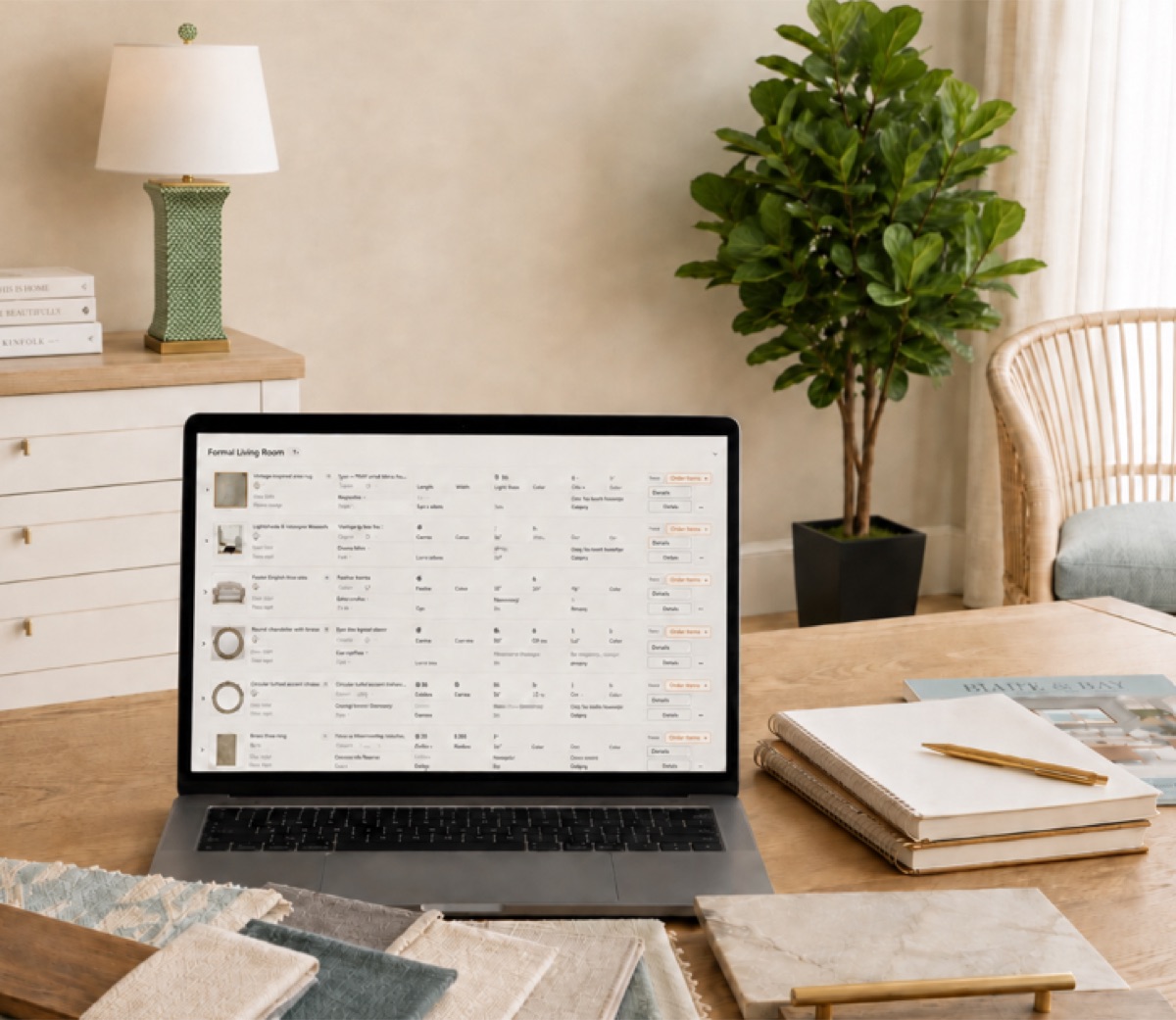
We share an online project dashboard where I add recommended furniture, dimensions, pricing, inspiration, and selections.
She can review everything from New Jersey, add things she has found online, ask questions, and keep the entire project organized by room.
She also visited her local Ethan Allen to see some of the furniture we had been considering in person.
Then she flew to Bluffton.
We spent two focused days visiting local showrooms, including Ethan Allen, John Kilmer Fine Interiors, and Gilman Floors.
Because we had done the planning ahead of time, those two days were productive. We were not wandering through stores hoping something caught our eye.
We already knew what each room needed.
We could sit in chairs, compare upholstery, look at wood finishes, evaluate rugs, confirm dimensions, and make final decisions.
We knocked out a tremendous number of the remaining purchases in those two days.
That is a very different experience from trying to furnish an entire Lowcountry home during a few frantic weekends before move-in. I also roped in my window treatment colleague on the same trip where I was gathering measurements for floorplans and furniture. Here again, I have my clients order directly from the fabricator, and I do not charge a mark-up on window treatments. The fabricator took all the measurements, and recommended options. Those automated soft woven blinds are now fully installed in my client's bedroom well ahead of her next visit.
What About Artwork, Lighting, Accessories, and Online Purchases?
Not everything comes from a furniture showroom.
There may be lighting, artwork, mirrors, bedding, accessories, occasional furniture, and other items coming from Wayfair, Perigold, trade vendors, or online retailers.
This is where being a small, flexible design firm can actually be an advantage.
For smaller items, I can often order through my trade account when appropriate and have things shipped directly to me.
I can unpack them.
I can inspect them.
If something is damaged, we find out before move-in day.
Then I can consolidate smaller items and bring them to the client's home rather than having dozens of individual boxes piling up on a front porch while the homeowner is several states away.
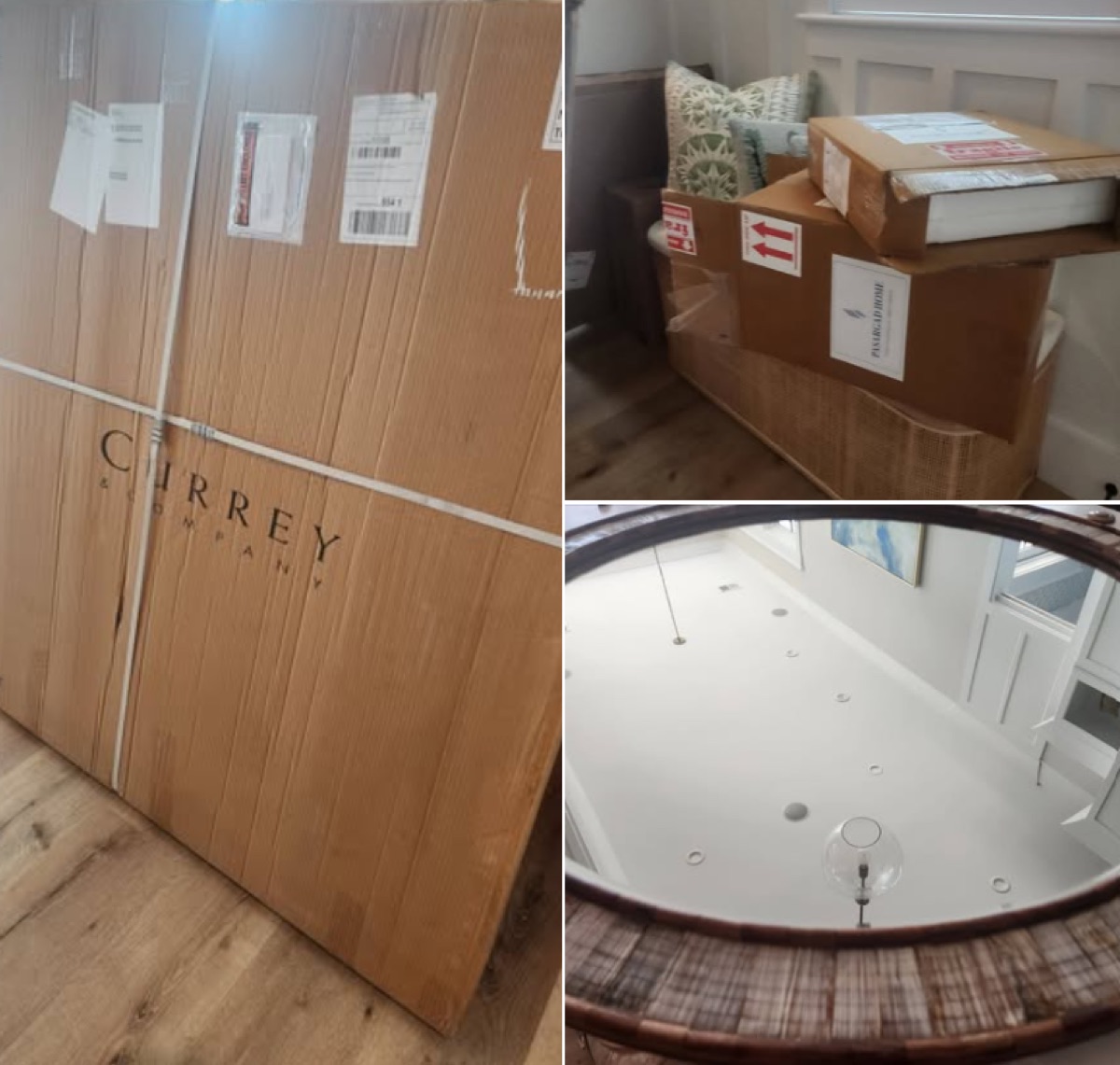
My husband might argue that his unofficial job description has become Chief Cardboard Box Officer, but it works. I'm going out to her home this week to accept delivery of the three rugs she selected, so I will take all the smaller pieces over in one trip.
Full Service Does Not Have to Mean High Overhead
There is sometimes an assumption that hiring a smaller design firm means sacrificing service.
I actually think it can mean the opposite.
I intentionally work with a smaller number of clients.
That gives me the flexibility to meet a delivery truck, stop into a furniture showroom, pick up a fabric sample, inspect a light fixture that arrived at my house, talk to your builder, or spend two days shopping with you when you fly into town.
For an out-of-state homeowner, those little things matter.
You still have someone local keeping an eye on the project.
You still have professional space planning.
You still have renderings and furniture selections.
You still have access to trade resources.
You still have someone coordinating the furnishing plan with what is happening during construction.
What you may not have is tens of thousands of dollars in additional procurement, markup, warehousing, and handling charges for services your project does not actually need.
Furnishing a Bluffton Home From Out of State Is Really About Having a Local Plan
You do not necessarily need a warehouse.
You do not necessarily need every piece of furniture to come from a trade-only vendor.
And you certainly do not need to wait until your house is finished before you start thinking about furniture.
You need a plan.
You need someone who understands the local furniture resources.
You need to know which retailers will store purchases, who services your delivery area, where you should place your orders, which items have long lead times, and when the major sales typically occur.
And perhaps most importantly, you need someone here who can be your eyes and ears while you are somewhere else.
That is the role I enjoy most.
At Bluff & Bay Interiors, I help bridge the gap between building a house in the Lowcountry and actually having a finished home ready for you to enjoy.
Whether you are building in Bluffton, Okatie, Hilton Head Island, Beaufort, or one of the surrounding communities, the goal is not to make the furnishing process more complicated or expensive than it needs to be.
It is to make smart decisions, coordinate everything early, and spend your design dollars where they actually make a difference.
Ready to start furnishing your home from out of state? Contact Bluff & Bay Interiors to schedule a consultation.