
Free In-Store Designer or Independent Interior Designer: What's the Difference?
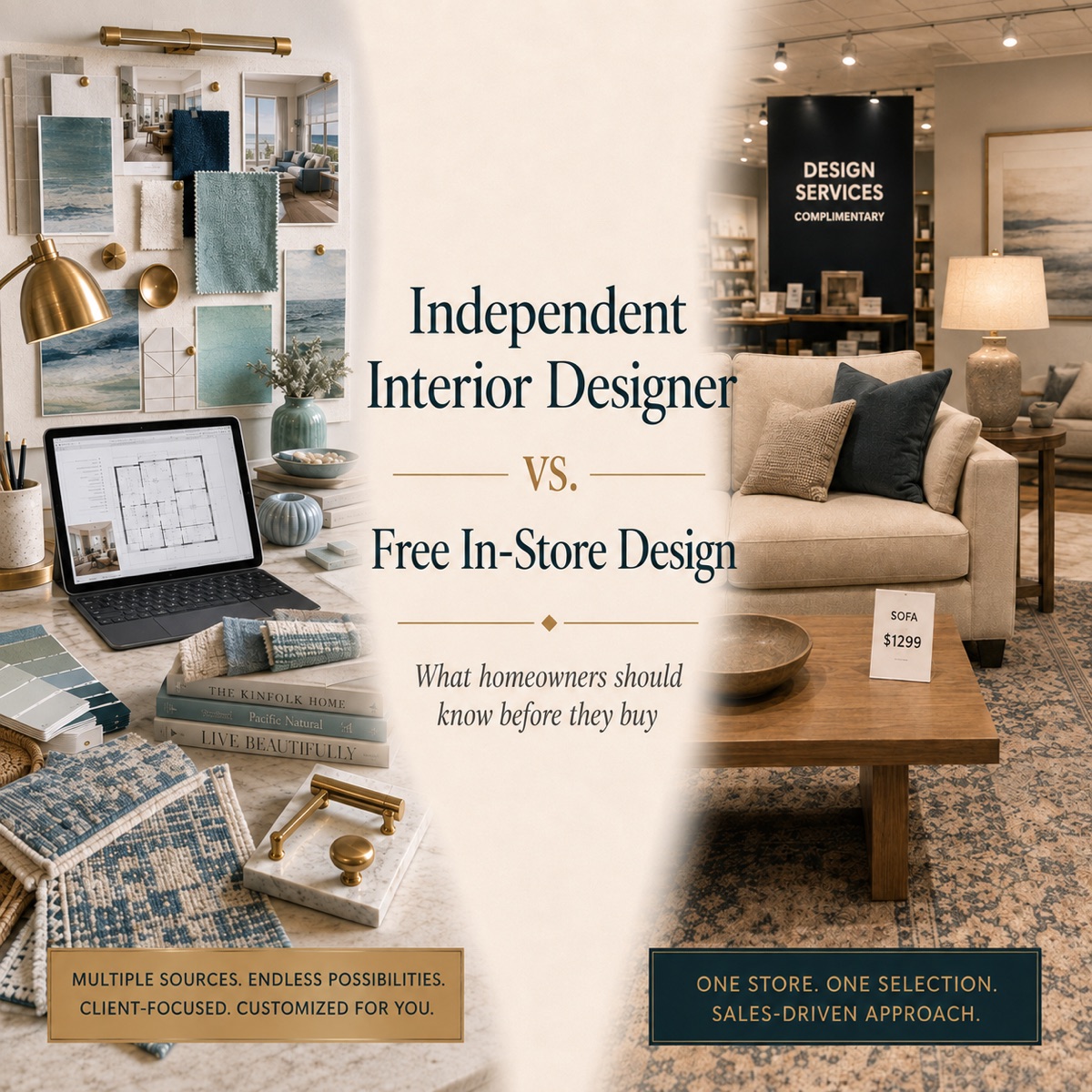
Many furniture stores offer complimentary design services as part of the buying process. On the surface, it can sound like an easy decision: Why pay an independent interior designer when someone at the store will help you for free?
The answer comes down to one important question:
Who does the designer ultimately work for?
I have worked on both sides of the furniture industry, as an in-store designer for Ethan Allen (in Bluffton and Savannah) and Bassett (in North Carolina), and now as an independent interior designer. There are talented, knowledgeable designers working in furniture stores, and many genuinely want to create beautiful homes for their clients. I certainly did.
However, the structure of an in-store design position and the role of an independent designer are very different.
The Limitations of "Free" Interior Design Services
In my experience, in-store design positions were entirely commission-based. Although I always wanted to help my clients make the best possible decisions, I was limited to recommending furniture, fabrics, finishes, rugs, lighting and accessories sold by that particular company.
That can be challenging when you know another retailer may have a piece that better suits the client's style, space, timeline or budget.
An in-store designer may recognize that a client would be better served by purchasing a dining table from one company, chairs from another and a rug from somewhere else. But the designer's job is still to sell products from the store that employs them.
At the end of the day, in-store designers are generally evaluated primarily on their sales numbers. Their performance is tied to how much they sell and whether they meet monthly goals, not necessarily whether the client explored every available option.
That does not mean an in-store designer is being dishonest or does not care about the client. It simply means the business model influences the process.
Why There Can Be Pressure to Buy Quickly
Furniture sales often involve monthly goals, promotional deadlines and commission structures. As a result, the focus can sometimes shift toward closing the sale rather than taking the time to thoughtfully compare options.
Clients may hear that a promotion is ending soon, inventory is limited, or prices are about to increase. Occasionally that urgency is legitimate. In other cases, the same or a similar promotion may return within a few weeks.
One of the advantages of working with an independent designer is having someone who understands how furniture promotions typically work.
For example, a 20 percent discount may sound significant, but for many retailers it is a fairly common promotion rather than the deepest discount of the year. An experienced independent designer can help you determine whether it makes sense to purchase now, wait for a better sale, or explore another source.
The goal is not simply to complete the purchase. It is to make the right purchase.
An Independent Designer Works for the Client
As an independent interior designer, my loyalty is to my client, not to one furniture manufacturer or retailer.
My clients pay me an hourly rate to act on their behalf. That means I can compare furniture, rugs, lighting, fabrics, finishes, pricing, quality and availability across multiple stores and manufacturers.
I am not trying to meet a monthly sales quota for one company. I am trying to find the best pieces for the client's home, style, lifestyle and budget.
Sometimes the right selection is from Ethan Allen or Bassett. Other times, it may come from Serena & Lily, Arhaus, Coastal Home in Bluffton, John Kilmer Fine Furnishings on Hilton Head, an antique dealer, a trade-only source, or a more affordable retailer.
A thoughtfully designed room rarely needs to come entirely from one store. In fact, mixing brands, price points, finishes and styles often creates a home that feels more personal, collected and distinctive.
Independent Design Can Help You Save Money
Hiring a designer is sometimes viewed as an added expense. However, a good designer should help clients spend their money more wisely.
The value is not always about finding the least expensive item. It is about knowing where to invest, where to save and how to avoid purchases that will need to be replaced.
An independent designer can help prevent costly mistakes such as:
- Purchasing a rug that is too small for the room
- Selecting wood finishes that clash rather than coordinate
- Buying a sofa that is the wrong scale for the space
- Choosing upholstery that will not hold up to children, pets or daily use
- Ordering furniture that will not fit through a doorway
- Selecting a dining table that leaves too little room for chairs and circulation
- Buying a low-quality piece simply because it appears to be a bargain
- Purchasing during an ordinary promotion while believing it is a rare discount
A rug that costs less is not a savings if it is the wrong size and must be replaced. A sofa is not a bargain if the cushions lose their shape within a year. A dining table is not a good investment if its finish clashes with everything else in the room.
Avoiding even one significant mistake can offset the cost of professional design guidance.
Access to More Choices Without Becoming Overwhelmed
One of the benefits of shopping at a single furniture store is convenience. The options are already narrowed down.
However, that convenience can also be limiting.
Shopping independently gives clients access to far more choices, but it can quickly become overwhelming. There are endless websites, fabrics, finishes, dimensions, price points and promotional offers to evaluate.
An independent designer helps narrow the market without limiting the client to one brand. I am routinely shopping and sourcing from all the furniture stores on Hilton Head, and in Bluffton and Savannah. I regularly make trips up to Furnitureland South outside of High Point, North Carolina, which is the largest furniture store in the world.
Rather than presenting hundreds of random options, I can identify a smaller group of pieces that work together in terms of style, scale, color, quality and price. The client still has choices, but those choices have already been carefully considered.
Understanding Quality Beyond the Price Tag
A higher price does not always guarantee better quality, and an affordable price does not automatically mean a piece is poorly made.
My experience working with two of the country's largest custom furniture manufacturers gave me a deep understanding of furniture construction, fabrics, finishes, customization and the sales process.
I know what questions to ask and what details to examine:
- Is the fabric appropriate for the way the furniture will be used?
- Is the cushion construction likely to hold its shape?
- Is the finish durable?
- Can a damaged component be repaired or replaced?
- Is the piece worth customizing?
- Is the upgraded fabric actually necessary?
- Is the furniture well made, or are you mainly paying for the brand name?
- Will the style still work if the client moves or updates the room later?
That behind-the-scenes knowledge helps me guide clients toward purchases that make sense for their homes, not simply products that photograph well online.
Coordinating Pieces From Different Retailers
It can be difficult to determine whether items from different stores will coordinate.
One retailer may describe a finish as natural oak, while another calls a very different color natural oak. Online photography can make a wood finish appear lighter, warmer, cooler or less textured than it looks in person.
The same is true for fabrics, rugs, metals and paint colors.
An independent designer can help coordinate these selections across brands. I use samples whenever possible and evaluate how colors, undertones, patterns, textures and finishes work together.
This is especially valuable when clients already own pieces they want to keep. Instead of starting over, we can build a plan around what they have and add new items from the sources that make the most sense.
A More Personal and Objective Design Process
My business depends on my clients having a positive experience.
Reviews, referrals and long-term relationships are far more important to me than closing a sale by the end of the month. I want clients to feel confident about their decisions and believe that the process saved them time, stress and money.
Sometimes my advice is to purchase a piece immediately. Sometimes it is to wait for a better sale. Sometimes it is to spend more for quality, and sometimes it is to choose the lower-priced option because the more expensive piece is not worth the difference.
I can give that advice because I am working for the client alone.
Is an In-Store Designer Ever the Right Choice?
Absolutely.
An in-store designer can be a helpful resource when you already love a particular furniture brand, intend to purchase most of the room from that store, and feel confident that its products align with your needs and budget.
The service can also work well for someone purchasing a single item or trying to select a fabric or finish within that retailer's collection.
However, when you are furnishing multiple rooms, mixing existing and new pieces, shopping across several retailers, or trying to maximize a specific budget, an independent designer can provide a much broader perspective.
The Bottom Line
A complimentary in-store designer can help you purchase from one furniture company.
An independent interior designer can help you design the entire room.
The difference is not simply whether you pay a design fee. It is whether the person advising you is representing the retailer or representing you.
My role is to help clients make informed decisions, find the best pieces at the best available prices, coordinate selections across multiple sources and avoid expensive mistakes.
The goal is not to fill a room with furniture from one brand. The goal is to create a beautiful, functional, personal home, and to make every dollar spent count.
If you are looking to redo a single room, or building a new home from the ground up here in the Lowcountry, I would love to help you with your next project.