
A More Flexible Approach to Interior Design in Bluffton: Full-Service Design Without Unnecessary Markups
Hiring an interior designer does not have to mean turning your entire project over to a large design firm, paying a markup on every piece of furniture, or paying for receiving, warehousing and delivery services you may not actually need.
There is absolutely a place for the traditional full-service design model. For a client furnishing a very large luxury home with dozens of custom pieces coming from many different trade-only vendors, having a design firm procure, receive, inspect, warehouse and install everything can make perfect sense.
But that is not what every homeowner needs.
At Bluff & Bay Interiors, I take a more flexible approach.
My clients want professional design expertise, thoughtful project management and someone helping them make smart decisions throughout the process. Many are building or renovating homes in Bluffton, Hilton Head and the surrounding Lowcountry while still living somewhere else.
They want help. They want someone local. They want a cohesive, beautifully designed home. But they may not need the overhead and expense that can come with a traditional large full-service design firm.
My goal is simple: use your design dollars where they add the most value, and cut out unnecessary layers where they do not.
How Does Full-Service Interior Design Usually Work?
There are many ways interior designers structure their businesses. Some charge hourly. Some use flat project fees. Some charge procurement fees or mark up furnishings. Many full-service firms manage everything from design and purchasing through receiving, warehousing and final installation.
For the right project, that level of service is extremely valuable.
A design firm may source furnishings from 15 or 20 different manufacturers. Pieces are shipped to a receiving warehouse, where they are unpacked and inspected. They may remain there for weeks or months until the house is ready, after which everything is loaded again and delivered to the home for installation.
There are real costs associated with each of those steps. You may be paying for receiving. You may be paying for inspection. You may be paying for storage. You may be paying for delivery from the warehouse to your home. And depending on the firm's pricing structure, there may also be a markup or procurement fee on the furnishings themselves.
For a project that truly requires that infrastructure, those expenses make sense. But I do not believe every client should automatically be put through that process. Sometimes there is a simpler way.
How Much Does an Interior Designer Cost in Bluffton?
Interior designers can charge in several different ways, which is one of the reasons comparing design firms can be confusing. You may see hourly fees, flat design fees, retainers, minimum furnishing budgets, procurement fees, furniture markups or a combination of several of these.
At Bluff & Bay, I prefer a straightforward hourly model. My clients know what they are paying me for:
- Design expertise
- Space planning
- Floor plans
- Renderings
- Furniture and finish selections
- Sourcing
- Builder and trade coordination
- Project management
- Delivery assistance
- On-site support when needed
My compensation is based on the professional design work and project management I provide. It is not based on how expensive the furniture I recommend happens to be. That distinction is important.
Why I Often Have Clients Purchase Furniture Directly
One of the biggest ways I help clients manage the overall cost of a project is by looking carefully at how furniture is purchased, stored and delivered. Many retailers already provide much of the infrastructure a homeowner needs.
If we purchase a dining room, living room or bedroom from a retailer that is willing to receive the furniture, inspect it, store it until your home is completed and then deliver it directly to you, it may not make sense to send that same furniture through an additional receiving warehouse. Why pay to move and store something twice if we do not need to?
Instead, I work with clients to understand:
- Lead times
- Expected completion dates
- Storage policies
- Delivery policies
- Return and cancellation policies
- Which pieces need to be ordered early
- Which purchases can wait
- How long a retailer will hold furniture
- Whether delivery can be coordinated with construction completion
From there, we build a purchasing plan around your home. You purchase directly from the retailer, while I remain involved in the overall design and timing.

Do You Really Need Furniture From 20 Different Vendors?
One of the things I learned while working in furniture retail is that a beautifully designed room does not need to come from ten different vendors. And a beautifully designed home does not necessarily need furnishings from twenty.
For many of my projects, approximately 80% of the major furniture can often come from two carefully selected retailers. Which retailers make sense depends entirely on the client.
For one home, it may be Serena & Lily and Coastal Home. For another, Ethan Allen and John Kilmer Fine Interiors may provide the right combination of upholstery, casegoods and finishing pieces. For a larger project, Furnitureland South may make sense because a client can access many different manufacturers through one retailer. We can still bring in a special cocktail table, lamp, rug, piece of art or accent chair from somewhere completely different.
The goal is not to limit your choices. The goal is to simplify the process without compromising the design.
Every additional vendor introduces another set of lead times, policies, paperwork, delivery schedules and possible complications. Sometimes more sourcing creates a more interesting home. Sometimes it simply creates more complexity. Part of my job is knowing the difference.
Trade Discounts Without Furniture Markups
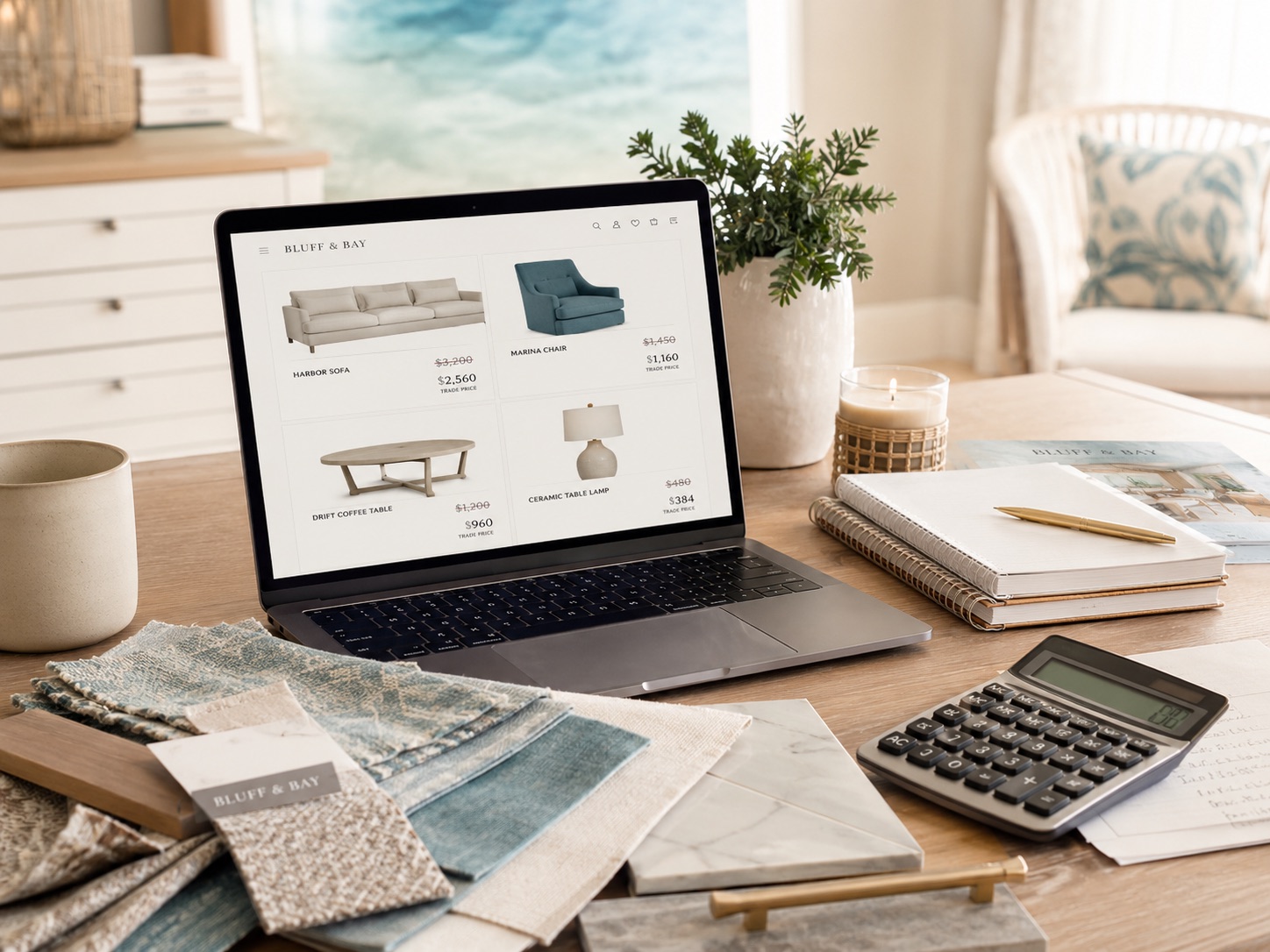
When I have access to trade pricing or a designer discount that can be passed along to my client, I do that whenever possible. I do not believe a client's furniture budget needs to become another source of profit simply because I helped select the pieces.
If we are comparing a $4,000 sofa with an $8,000 sofa, my compensation does not increase because you choose the more expensive one. That allows me to focus on one question: which sofa makes the most sense for you?
Sometimes spending more is absolutely worthwhile. Sometimes it is not. Maybe the main living room deserves the investment while the guest bedroom that gets used a few weeks each year does not. Maybe we splurge on the dining table and save on the console. Maybe the expensive chair is worth it because it is the chair you will sit in every evening.
Good design is not about buying the most expensive option in every category. It is about understanding where your money will make a meaningful difference. Because I am not earning more based on the price of the furniture, I can help you make those decisions based on the project rather than based on what generates the largest furniture sale.
Full-Service Interior Design for Out-of-State Clients
A more flexible business model does not mean less service. In fact, for many of my out-of-state clients, I become the local point person for all the smaller purchases that do not fit neatly into a major furniture-store delivery.
We may have ordered the sofa, dining table and bedroom furniture through two primary retailers, but we still need lamps, occasional tables, counter stools, mirrors, bedding, accessories or other pieces from Wayfair, Perigold or additional online retailers.
When it makes sense, I can purchase those items through my trade accounts, apply any available trade discount for the client, and have everything shipped directly to me. I receive the packages. I unpack them. I inspect the pieces. I keep everything together. Then, rather than having a client manage a constant stream of boxes arriving at an empty home, I can bring the pieces over in one consolidated delivery. For someone living hundreds of miles away while their Bluffton or Hilton Head home is being completed, that can make a huge difference.
And yes, there can be a lot of boxes. My husband sometimes jokes that being married to an interior designer means he has a second job breaking down cardboard. But behind the humor is another example of how I try to make the process easier.
You can still have someone local receiving purchases, checking for damage, keeping track of what has arrived and getting everything into the house without automatically putting every item through a commercial receiving warehouse.
The level of service should fit the project. Sometimes the smartest solution is letting a major retailer store and deliver the furniture they sold you. Sometimes it makes sense for me to receive smaller pieces locally and consolidate them. And sometimes a project really does require traditional receiving and warehousing. My job is to determine which approach makes the most sense for your home, your timeline and your budget.
Who Handles Furniture Deliveries If You're Out of State?
This is one of the most common concerns for clients building or furnishing a home from another state. Purchasing furniture directly does not mean you are on your own when delivery day arrives.
I can be at the house when furniture is delivered. I can help inspect pieces as they come in, review placement and make sure the furniture is being installed according to the plan we created. If something arrives damaged, we can identify the issue. If a piece needs to be moved, we can address it while the delivery team is there.
If you cannot be in South Carolina, you do not necessarily need to fly back every time a delivery is scheduled. Sometimes what you need most is simply a trusted person with eyes on the project.
A More Flexible Approach to Remodeling in Bluffton and Hilton Head
I take a similar approach with renovation projects. You remain in control of choosing your contractor and trade partners. You may find them through your own research, recommendations from neighbors or professionals I can refer to you. I can then help coordinate the design side of the project.
If you live out of state and a tradesperson needs access to the house, I can often meet them there. If a cabinet company needs clarification, I can help. If the electrician needs to understand where a fixture should be located in relation to the furniture plan, we can coordinate that. If tile, flooring, plumbing or lighting selections need to work with the overall design, I can help make sure those individual decisions connect.
My role is not to insert another layer between you and every professional working on the home. My role is to help connect the pieces so the finished home works together.
Why I Use Trusted Retail and Trade Partners
Another way I help clients control design costs is by recognizing when someone else can efficiently handle part of the work. I have long-standing relationships with people throughout the furniture and home furnishings industry.
When we are purchasing through a retailer where I have a trusted design colleague, I may bring that person into the process. They may be able to check product specifications, provide information about construction or fabrics, help with pieces available through their store, or assist with a portion of the floor plan. That service is already part of what the retailer provides. Why should my client pay me for additional design hours to duplicate work that a knowledgeable retail designer can handle?
I remain involved in the overall plan. I make sure the selections relate to the other rooms. I can review dimensions, finishes, color and scale. But I do not need to personally perform every single task simply because I am the designer managing the project.
I sometimes think of these trusted retail relationships almost like having an extended design team. They provide expertise when we need it, without the client paying for the overhead of a large staff sitting inside my own company.
Window Treatments Without Another Layer of Markup
Window treatments are a perfect example of this philosophy. Custom window treatments can be a significant investment. Rather than purchasing treatments through Bluff & Bay and adding another layer between the client and the fabricator, I work directly with a local window treatment fabricator I used when working as a designer at Ethan Allen.
They can come directly to the home. They measure. They understand the fabrication requirements. They handle the technical side of the project. They can work directly with the homeowner.
I remain involved in the design. I can help select fabrics, review colors, bring samples and make sure the treatments relate properly to everything else in the room. But I do not need to spend hours measuring every window, preparing fabrication orders and acting as the middleman between the client and the person actually creating the treatments.
The specialist does what they do best. I do what I do best. The client receives professional custom window treatments while avoiding an unnecessary extra layer of markup.
Where Your Design Dollars Really Go
This philosophy carries throughout the way I work. It is not about cutting corners. It is about cutting unnecessary costs. There is an important difference.
I would rather see the money you spend on your home actually show up in your home. Maybe that means better upholstery. Maybe it means a handmade rug. Maybe it means beautiful drapery. Maybe it means upgrading the dining chairs because you are going to use them every day. Maybe it means purchasing the piece of art you absolutely love. Or maybe it means investing in custom cabinetry or millwork that would be very expensive to add later.
Those are things you will actually see, use and enjoy. I would rather help put your budget there than automatically direct it toward redundant receiving, storage, procurement or administrative layers that your particular project does not require.
Is This Approach Right for Your Project?
There will always be projects where a large traditional full-service design firm is exactly the right choice. If you want a large team sourcing highly customized pieces from dozens of trade vendors, purchasing everything on your behalf, warehousing it and orchestrating a single large installation, that model may make perfect sense.
But there are also many homeowners looking for something different. You may be building a home and need someone thinking about your furnishings while the house is still under construction. You may be relocating to Bluffton, Beaufort, or Hilton Head and need someone local who can attend meetings, receive purchases or be at the house when you cannot. You may want a professionally designed home and have a substantial furnishing budget, but still want to make thoughtful decisions about where that money goes. You may want renderings and floor plans before making expensive purchases. You may want someone coordinating the builder, retailers, tradespeople, furnishings and deliveries. And you may simply prefer knowing exactly what you are paying your designer for.
At Bluff & Bay Interiors, my clients are paying for my design expertise, time, planning, sourcing, renderings, coordination and project management. They are not required to purchase every furnishing through me. They are not paying me more simply because I recommend a more expensive sofa. And they are not automatically paying for an entire receiving and warehousing infrastructure when their project does not require one.
Instead, we build the level of service around the project. That may mean coordinating furniture purchases through two primary retailers. It may mean receiving Wayfair and Perigold orders for an out-of-state client. It may mean meeting tradespeople at the house. It may mean managing deliveries. It may mean bringing in trusted retail and trade partners who can reduce the number of design hours you need. Or it may mean doing all of those things together.
Professional interior design. Thoughtful project management. Full service when you need it, without paying for unnecessary layers when you don't.
That is the more flexible approach behind Bluff & Bay Interiors.